
We Know Them by Numbers
The Human Side of Condors and Lead Poisoning, Pete's $100,000 Piano, The Felice Brothers

I wrote this essay in 2020 with the intent of reaching the large audience this topic deserves. It’s a first-hand account of the effects of lead poisoning on condors and the people devoted to their recovery. I pitched it to over a dozen outlets but it generated scant interest. Those that passed on it were gracious in their rejection and some offered feedback: they’d just run a condor/lead story, or were looking for something uplifting. One publisher rejected it because they felt I was too close to the subject matter to approach the topic objectively; hell, that’s a strength. My insider’s perspective makes it a compelling human interest story, an aspect you’d lose if written by anyone outside the condor program. A couple of places wanted it as a sub-feature; the catch is that it had to be under 1,000 words, cut in half. No way.
I bet on myself and lost, and here in 2026 too much time has passed to keep trying. So it’s going on Substack, and if only 30-40 people read it, well, I couldn’t find a better group to share it with than you all. Hope you like it.
WE KNOW THEM BY NUMBERS
We know them by numbers. It’s easier that way—practical, efficient. They’re chronological: the older the bird, the lower the number. California condors wear those numbers on vinyl wing tags, along with tracking devices— radio transmitters and GPS units. That’s how we knew #463 was in trouble—we hadn’t picked up his radio signal in over a week, while his GPS revealed he’d hardly moved in eight days, sequestered in a canyon north of Pinnacles National Park.
Like many California condors, #463 was the product of a highly successful captive- breeding program, hatching at the World Center for Birds of Prey in Boise, Idaho in 2007. He arrived at Pinnacles in 2009, where he spent several months getting acclimated to the area in a remote flight pen before being released. He’d since come of age, establishing a territory in the park’s High Peaks area, where he’d become a visitor favorite. His predicament had us worried.
For a year that started so promisingly—the central California flock reached a population milestone in spring, surpassing 100 condors—the end of 2019 was dispiriting. In mid-December we managed to capture one obviously ill condor, only to learn he died while undergoing treatment. Two days before Christmas I picked up a mortality signal while tracking another south of the park; her limp body was recovered on a frigid hillside December 26. Yet another was rushed to the Los Angeles Zoo for treatment on Christmas Eve. And now, #463. Crew leader Alacia Welch contacted the property owner, who granted permission to me and park service wildlife biologist Gavin Emmons, a raptor specialist, to ride out with the ranch manager to locate #463.
We met the manager at ranch headquarters, bringing with us a kennel, two nets, and tracking gear. We hopped in the back of an ATV and followed a dirt road that paralleled a stream for several miles until we approached a lone, leafless cottonwood. Beneath it was what was left of a steer that #463 had been seen feeding on several days before. There was indeed a large bird on the carcass, but it was a golden eagle and it took flight as soon as the driver cut the engine.
I had expected, based on GPS, to see #463 perched in the cottonwood’s open branches, but he was nowhere in sight. The antenna and receiver, which seemed hardly necessary earlier, suddenly became essential. I anxiously tuned the receiver to #463’s frequency and picked up a faint signal. For the first time in eight days, #463 had flown. He was somewhere up on the steep, grassy slope to the north. Perhaps there was a glimmer of hope: two months earlier #463 flew thirty miles north and abruptly stopped moving. So certain were we that he’d died that Alacia and Gavin went to retrieve his body. When they arrived they were stunned to see #463 perched atop a rock outcrop. They were happy to come back to the park empty handed, and two days later #463 returned as well, flying back apparently healthy. Perhaps this was more of the same.
The ATV forded the shin-deep creek, dropping us off on the other side. I kept the receiver on, following the beeps as we climbed. They led to a gully—not the type of place you’d expect to find a healthy condor. I worked the signal along the rim while Gavin hiked down.
I can’t think of anyone better suited to that task. Five years ago we picked up a mortality signal for a condor near the top of Mt. Defiance (the receiver beeps twice as fast when the transmitter hasn’t moved in ten hours). That mountain is appropriately named; though not the highest peak in the park, its slopes are dauntingly steep and covered in brush and scree. There are no hiking trails up that godforsaken incline, and you’ve got to be near peak physical condition to reach the summit. Gavin headed up toting the condor equivalent of a body bag to retrieve the carcass. He wasn’t ready for what he found near the top: the condor was alive, but barely. I don’t know how Gavin summoned the strength and fortitude to carry that dying condor all the way down that treacherous slope, only to see it perish in his arms just before he got back. If anyone could handle this delicate situation, it’s Gavin.
Gavin’s voice shot out shortly after he descended.
“Here he is.”
#463 stood stoically across the gully, hemmed in by chamise and a near-vertical hillside. He’d managed to fly across the stream, but the wings that had carried him over 10,000 miles in his life could no longer function.
“I’ll get the nets” I said.
“No need; I got him.”
Gavin extended his hand and gently secured the head, encircled #463 with his other arm, and brought him against his chest. #463 was in bad shape— besides being unable to fly, his full crop suggested his digestive tract was paralyzed. Back at the ATV, Gavin placed him in the kennel. Alacia had alerted the LA Zoo, but it was too late in the day to take #463 to southern California. I offered to drive him down in the morning, New Year’s Eve day.
* * *
Lead. It’s an element, a metal, first harnessed by humanity over six thousand years ago and used for an impressive assortment of purposes. But for all its virtues and versatility, inside a body lead is a sheer toxin with no redeeming qualities. It’s been linked to a bevy of ailments—cognitive impairment, cardiovascular disease, and infertility, to name just a few. Humans have suffered its effects for ages, but no species has been devastated by lead like the California condor.
Since condors were reintroduced to California’s central coast in 1997, lead poisoning has accounted for half of the deaths for which a cause has been determined. To put that percentage into perspective, the two leading causes of death for humans in the US, heart disease and cancer, don’t claim that much combined. And it’s not just a regional problem—lead poisoning is the primary cause of death for condors in southern California and Arizona as well.
Lead has become an unrelenting fact of life for condors. An analysis of feather samples conducted by UC Santa Cruz revealed that a typical condor in central California endures a bout of lead poisoning seven times per year. The specter of lead looms over every aspect of condor management— it’s the main reason for all the tracking paraphernalia, and why we monitor every condor in the flock seven days a week, 52 weeks a year. And while GPS provides a trove of sophisticated information, its most important function is to simply confirm that a condor’s still flying. So pervasive is lead poisoning that we resort to trapping condors regularly to test lead levels in their blood; over 20% have levels high enough to warrant chelation. Isotopic analysis of the lead in those blood samples shows it coming overwhelmingly from one source: ammunition.
When a lead bullet penetrates flesh, it shatters and numerous particles disperse, lodging in tissue. When condors feed on animals killed with lead bullets they end up ingesting those particles.
There’s a common misperception that condors are highly sensitive to lead. Far from it. The average US citizen has a blood lead level under two micrograms per deciliter. The Center for Disease Control and the National Institutes of Health consider anything over five elevated. Condors have been documented flying with levels over 800, some showing no outward signs of illness. Condors are actually amazingly resilient in the face of lead poisoning, but remain highly susceptible because they feed exclusively on carrion. Their reproductive rate doesn’t do them any favors either: a breeding pair typically produces just one chick every two years. That’s among the lowest of any wildlife species in North America. And just as California condors aren’t sensitive to lead, neither are they an ancient, senescent species, as the outdated trope implies. Time hasn’t passed them by; their food supply is being poisoned, one bullet at a time. The lifespan of a California condor is at least fifty years. Whether or not one will fly for even ten is basically a coin flip.
* * *
December 31 broke chilly, a California-cold 25 degrees, as Gavin and I loaded #463’s kennel into the back of an SUV at daybreak. I left the park behind on the 5-hour journey to LA, past the fertile fields of the Salinas Valley—Steinbeck Country—down Highway 101. I headed east at Paso Robles along the same road that took the life of James Dean, toward the hazy sunshine of the San Joaquin Valley and Highway 5. Playing the sound system was out of the question—no need to stress #463 with extraneous human noise. Likewise, I couldn’t drive with the windows down, which was most unfortunate, because #463 had hacked up the contents of his last meal. The English language has no adequate adjectives to describe the fragrance of regurgitated carrion.
I left feeling anxious. I hadn’t planned on stopping, but the fuel gauge changed my mind, so I grudgingly filled up at the base of The Grapevine. Decades ago, my grandparents took my brother and me to Disneyland. Even as a child I wasn’t keen on rides, crowds, or cartoon characters, but I knew that condors sometimes flew over Tejon Pass, and just the thought of glimpsing one made the trip worthwhile. A half-century later I’m driving a very sick condor through that same pass, but the hopefulness of childhood has given way to helplessness. All the while #463 was disturbingly quiet. Condors lack vocal cords, but even a marginally healthy bird would have been moving around, its feet clattering against the kennel floor. His silence only added to my anxiety. I couldn’t get to LA fast enough.
I finally arrived at a gated entrance where two technicians led me to the zoo’s veterinary center. In addition to being one of four captive breeding sites, the Los Angeles Zoo is also the premier location for treating sick or injured condors. I could think of no better destination for #463.
The technicians placed the kennel on the floor and opened the door, but #463 remained inside. Perhaps, they speculated, he’d lost the use of his legs. They removed the top of the kennel. #463 barely resisted when they lifted him out to weigh him.
“Sixteen pounds” the technician announced.
Not good; male condors typically weigh twenty or more. They wrapped #463 in a protective vest before laying him down beneath an X-ray machine. Then it hit me.
Condor deaths come with the territory, and I’d absorbed dozens over the years. But seeing #463 lying there helpless, swaddled in a vest, hit me hard, much harder than yesterday when Gavin found him flightless in the gully. You can study reports and read technical papers, you can absorb statistics, peruse percentages, and sift through numbers in an effort to understand what’s going on with lead poisoning and condors. But if you really want to know what lead poisoning looks like, it’s this: a gravely ill condor, grounded and bound, awaiting a radiograph scan.
We know them by numbers—professional, logical, pragmatic, nothing if not scientific. Numbers lack the emotional encumbrance of names, yet those numbers still allow us to experience every condor as an individual, and that’s the sticky part. I’d known #463 for nine years, from gangly juvenile to breeding adult. I’ve radio-tracked him thousands of times, jotted down his GPS location on hundreds of mornings, and saw him weekly. Sometime along the way he became part of my life, though I struggle to describe his role—neither friend nor pet, but something vastly more meaningful than an interchangeable member of a wildlife population, or a sterile number.
We gathered around a computer screen to view the eerie black and white images. To no one’s surprise they showed several ominous fragments in his gastrointestinal tract.
* * *
They transferred #463 to the intensive care unit. It was time for me to go. One of the technicians was kind enough to walk out with me.
“He perked up when we put him in the ICU. He even bit me!”
She was trying to cheer me up. Perhaps she sensed the emotion I’d tried so hard to suppress. I wanted to ask for her prognosis, but we both knew.
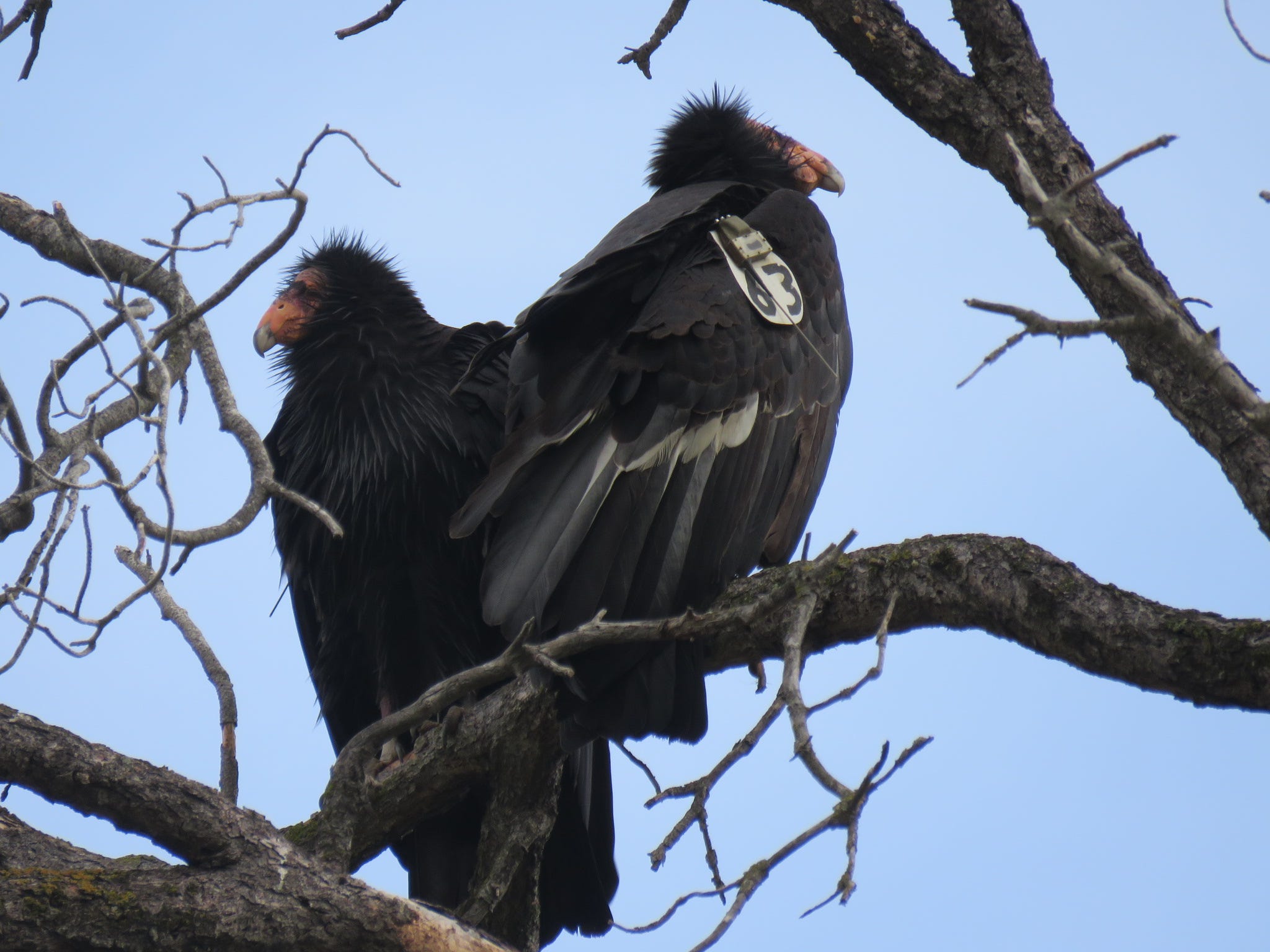
Condor #463 (R) with his then-mate, #583, perched together in 2017.
Helena Handbasket: I saw a list of annual expenses for the Defense Department earlier in the week. You may have as well; it was all over the news. For an administration that preaches austerity, there were a lot of extravagances: hundreds of thousands on donuts, $7M on lobster tail in one month. Seems to me the Commander in Chief would’ve scuttled expensive shellfish for filet o’ fish sandwiches, but evidently Whiskey Pete has refined tastes.
But the item that really caught my eye was a $98K piano, a spanking-new Steinway ticketed for the home of the Air Force Chief of Staff.
Steinways have long been considered the Cadillac of piano brands, but you pay dearly for the name. It’s Billy Joel’s piano of choice, but his only cost $50K. Me, I prefer Bluthner. They feature an extra string on the higher notes, giving them a brighter sound. Brahms, Liberace, Wagner (Richard, not Robert), and Tchaikovsky owned Bluthners, while Rachmaninoff said the only two things he took with him to America were his wife and his Bluthner.
With the likely exception of Robert Wagner I’m many rungs lower on the virtuoso ladder than anyone in the prior paragraph, but the first and only conventional piano I’ve ever had was a second-hand Bluthner built in Germany in 1915. Cost me $10K and took up most of a room when I lived in Morgan Hill. When my marriage ended the piano remained behind— you couldn’t shoehorn a baby grand into the place I moved to. I switched to digital pianos and haven’t looked back.
Digital pianos are, in many respects, a better option: they’re much cheaper, use less space, are more versatile, and their voicings are amazing— they can precisely emulate the sounds of dozens of keyboards, from accordion to Fender Rhodes to Hammond organ, as well as string instruments, and if you need to change key you can do so with the click of a button. On top of all that, the sound quality is incredible. What more do you want?
In a word, durability. A traditional piano can last centuries; digital pianos wear out. By 2020 mine was on its last legs, so I went to a Yamaha dealership in San Jose to buy a replacement.
Piano dealerships aren’t nearly as frenetic as car dealerships, and the day I went there was only one other customer present. While the salesperson— no need for more than one— was with her I browsed around. I went straight for the grands, the cheapest of which was $12K. I tried out all the pianos in the section, the most expensive of which cost $50K. I gotta say, the difference wasn’t that noticeable.
But there were other pianos beyond, cordoned off. They went for $100K and up, but were off-limits, like precious Ming vases. You had to be a serious buyer to even hover over them, let alone play them. The most expensive went for $275K.
By then the attendant was ready to assist me. I ended up buying a moderately high end digital piano for $4700. But before I left I couldn’t help inquire about the ultra-expensive pianos in the verboten section. I knew not to ask if she’d bend the rules and allow me to play a couple of bars on an instrument worth more than most homes in Mississippi.
“Do you actually sell any of these or are they just for show?”
“Occasionally.”
“Who buys them? Classical pianists? Concert halls?”
“Tech moguls.”
“Do they even try the merchandise?”
“Sometimes, but not always.”
“Those that play, are they any good?”
She smiled before replying:
“It’s about prestige, not talent level.”
Of course. Just like an Air Force Chief of Staff picking out a piano worth more than the one played by the Piano Man himself. My guess is he couldn’t tell the difference between a $100K Steinway and a $12K Yamaha, and that’s fine— if he’s spending his own money. But this came from our tax dollars, money stripped from USAID and dozens of beneficial social programs. I guarantee you he could’ve purchased a digital piano with incredible sound for well under ten grand. Seems like something DOGE would’ve insisted upon, but government efficiency has never really applied to the defense budget, where, if anything gets cut, it’s veteran’s benefits.

Henderson’s shooting stars (Primula hendersonii) now blooming all over shaded sections of the property.
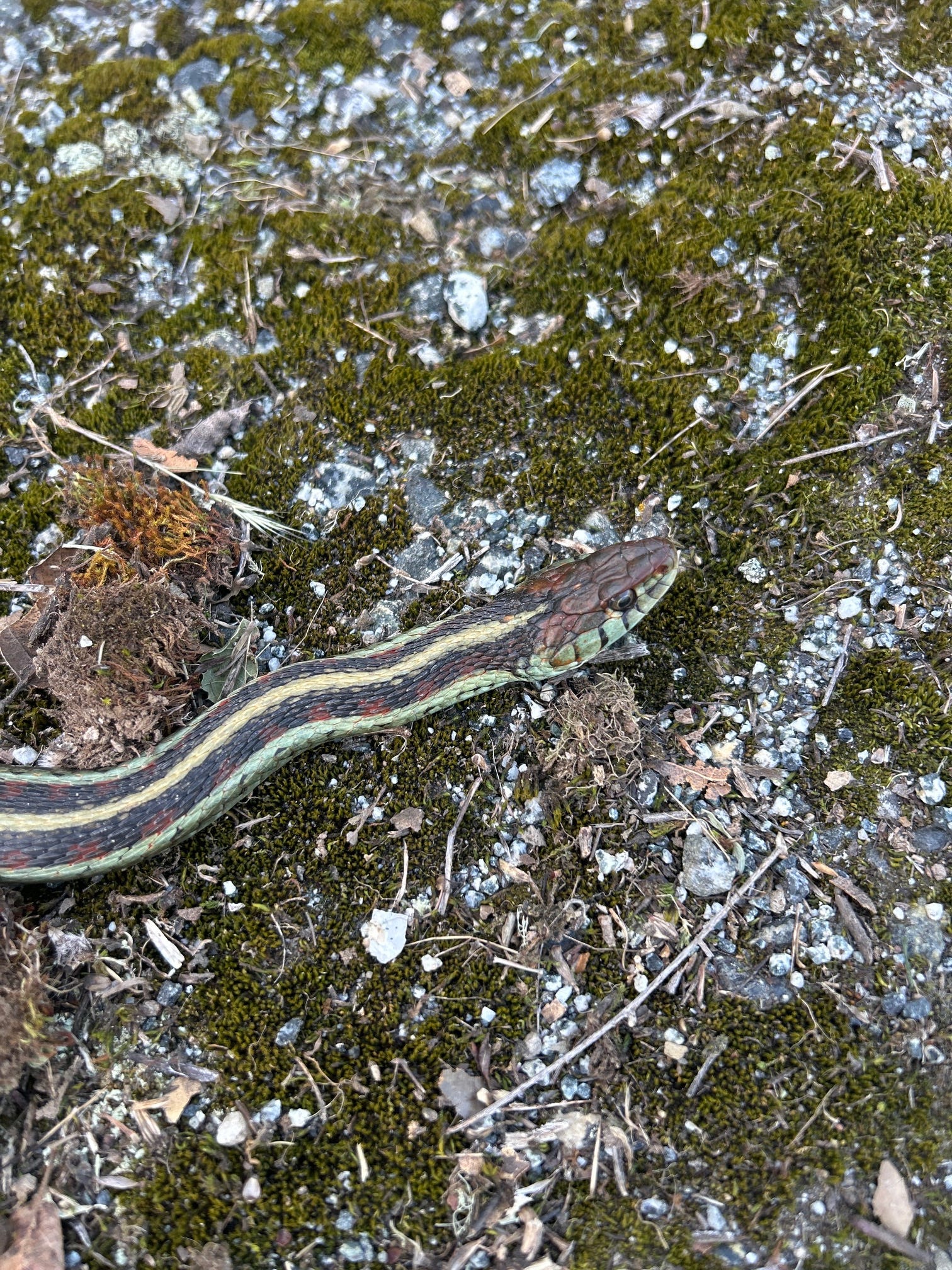
For those willing to brave the rabbit hole of garter snake identification to the subspecific level, this is Thamnophis sirtalis fitchi, with a range extending north as far as southern Alaska. The coastal subspecies, T. s. infernalis, can be found a few miles west in Henry Coe State Park, but I’ve never encountered them on my land.
Song of the Week: Run Chicken Run, The Felice Brothers
The purpose behind the Song of the Week feature is to share the music I love with readers, and while I could always spotlight classics like American Pie, the challenge is to introduce you to songs and artists you’ve never heard of. This week’s selection probably hits on both fronts. The Felice Brothers hail from upstate New York and cut their teeth busking in NYC subway stations. Their first album came out in 2005 and for the life of me I don’t understand why they didn’t rocket to the top of the Americana genre like, say, Mumford and Sons. My guess is they were never very concerned with grabbing the brass ring, content to remain a largely regional band. Aside from a 7-song set last October at Hardly Strictly Bluegrass last October in Golden Gate Park, they haven’t played in CA since 2021. For me they may be the only, and I mean only act worth driving the streets of San Francisco to see.
Thanks for sharing this, Joseph. After losing 986 this week, it was especially striking to read. I wish things could finally change, but it's the same story even years later.
This one got me. I remember the fall of 2009 we were hit pretty bad with lead and more of our flock was in the zoo or in Alacia's garage than was flying free. I always told visitors that asked about names that their numbers became their names to us. 303 hit me hard, but there were so many that by the time I left in 2013, I had to push all of it into a different compartment of my brain. Thank you for writing this, good to know someone else felt the same.